Black Beauty
Black BeautyBlack Beauty is the horse whose first-person life story gives Anna Sewell’s The Autobiography of a Horse its distinctive moral perspective. Passed among owners and renamed for different roles, he experiences the consequences of both considerate care and careless labor directly. His eventual recovery gives the narrative a hopeful ending, but the force of that ending depends on the accumulated evidence of what horses endure when people ignore their needs.
Identity and Early Formation
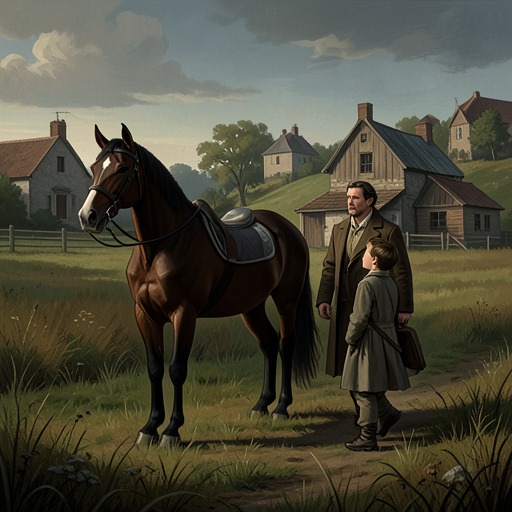
Black Beauty begins life in a large meadow with a clear pond, shade trees, a grove of firs, and a running brook. As a young foal he stays beside his mother, feeding from her and resting close to her at night. When he is old enough to eat grass, she goes out to work during the day and returns in the evening. This early setting establishes a contrast that follows him throughout the book: the needs of a horse can be met through attentive routines, or overlooked when work and convenience take priority.
At four, he is a handsome black horse with a white foot and a white star on his forehead. Squire Gordon examines him before buying him, and his first master undertakes his training rather than handing him over to someone likely to frighten or hurt him. Black Beauty’s explanation of being broken in is broader than simply learning to wear a saddle: a horse must accept a bridle, harness, and vehicle, obey directions, and endure work without choosing when to stop. The account makes clear that training can demand the surrender of a horse’s own will. In his case, familiar handling, oats, patience, and gentle treatment help him accept the bit and bridle.
His name is chosen for his appearance and expression, rather than for a grand or fashionable sound. The name Black Beauty therefore identifies more than his coat: it attaches attention to his character and intelligent eye. The narrative later shows how easily this identity is obscured as new people assign him names suited to their own familiarity or use.
Service, Care, and the Cost of Work
Under Squire Gordon, Black Beauty experiences riding and service within a household that attends to his welfare. When he is urgently ridden to bring a doctor to his mistress, he carries the doctor back despite his exhaustion. He then becomes seriously ill with inflammation of the lungs. John Manly nurses him through the illness, while the episode also shows how care depends on practical knowledge: Joe Green initially fails to cover him warmly after the ride, but John recognizes his distress and tends to him. The horse’s account presents the event through his physical limits and his understanding that the journey mattered because his mistress’s life was at stake.
Later, the consequences of less attentive management become apparent at Mr. Barry’s. Black Beauty receives little exercise despite being fed as though he were working hard; his health and spirits suffer, and he is given medicines in place of the exercise and changes in diet he needs. When a farrier examines his tender feet, he diagnoses thrush and links it to dirty stable litter. Cleaning the stall, changing his food, and treating his feet help him recover. Mr. Barry, having lost confidence in his grooms, decides to give up keeping a horse, and Black Beauty is sold again. The episode links an animal’s condition to stable management rather than treating illness as an inexplicable flaw in the horse.
His injuries later leave lasting marks. After Reuben Smith’s fatal ride, Black Beauty is led home slowly, and his knees require a long course of treatment. The wounds heal, but the resulting blemish remains, and the evidence at the inquest—including his lost shoe and testimony about Smith’s intoxication—clears Black Beauty of blame. His damaged knees subsequently shape how people judge his fitness, even when they cannot know how the damage occurred. The distinction between a horse’s visible condition and the circumstances that produced it recurs in his later life.
Names, Companions, and London Work
The changes in Black Beauty’s names register the changes in his circumstances. Lady Anne chooses him as her riding horse and calls him Black Auster. When Jerry Barker buys him for cab work, Jerry and Polly Barker call him Jack, continuing the name of a former horse. Jerry does not know who caused his broken knees and chooses to give him the benefit of the doubt. Later, when he is working under another name, he is called Blackie; during his recovery with Mr. Thoroughgood’s family, Willie calls him Old Crony because the horse comes to him and follows him in the field. These names mark new relationships, but the horse remains recognizable to people who knew him before.
As a cab horse, Black Beauty benefits from Jerry Barker’s attention to fit and pace. Jerry checks that the collar and bridle are comfortable and adjusts the crupper; the harness is plain, without a check-rein. He refuses to drive faster merely because passengers offer extra money. When another driver, Larry, takes passengers who want to hurry to a train, he sets off hard with his tired horse, while Jerry stays with a fair pace and pats Black Beauty. Their contrast makes Jerry’s restraint visible as a practical choice, not an inability to work quickly.
A meeting with Ginger brings the costs of their different experiences into view. Once a spirited and admired horse, Ginger now appears worn down by hard work, and she recognizes Black Beauty beside the cabs. Their reunion is a personal encounter and a wider reminder that a horse’s present condition carries a history. Black Beauty’s own working life also reaches a crisis under Nicholas Skinner. On Ludgate Hill, exhausted beneath a heavy load and repeatedly urged onward, he falls and cannot rise at first. People loosen the tack and give him help; he is taken to a nearby stable, where he receives rest and warm gruel. A farrier judges that overwork, rather than disease, has left him without strength, but Skinner says he has no meadow in which to nurse him and intends to sell horses when they can no longer work.
Recovery and Recognition
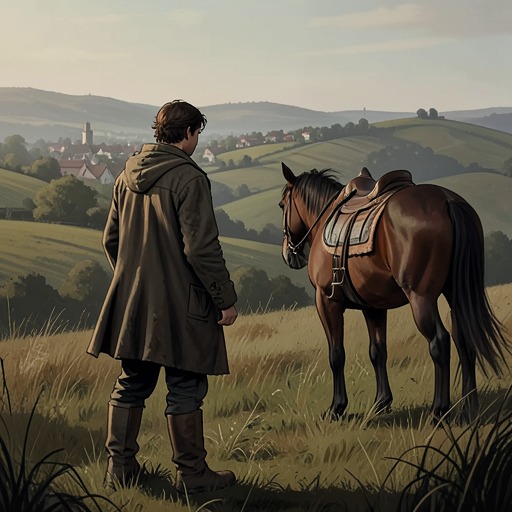
Black Beauty’s recovery begins when Mr. Thoroughgood takes responsibility for him and gives him rest, regular hay and oats, and the run of a meadow. Willie is entrusted with his care and visits every day, bringing treats and kind attention. The boy’s name for him, Old Crony, grows out of their companionship. Mr. Thoroughgood watches the improvement in his legs, while the combination of rest, good food, soft turf, and gentle exercise gradually restores his condition and spirits. By March, he can be tried in a phaeton and performs the work with ease.
His identity is finally recognized through specific bodily marks. Joe Green notices the white star, the white foot, the small knot left where Black Beauty had been bled, and the patch of white hair on his back that John Manly had called Beauty’s three-penny bit. These details allow Joe to connect the recovered horse with the one he had known at Birtwick Park. Black Beauty responds to Joe as a friend, and Joe expresses regret that the horse had been badly treated elsewhere. Recognition here is not based on a name or a claim of ownership, but on close attention to the particular horse and his history.
Ending and Narrative Significance
At the end, Black Beauty has lived for a year in a place where Joe Green is a kind groom, the work is easy, and his strength and spirits are returning. Willie continues to treat him as a special friend, and the women of the household promise that he will never be sold. His final security contrasts with the repeated sales and uncertain care that marked much of his working life. He often imagines himself back in the orchard at Birtwick Park among old friends, joining the recovered present to the remembered home of his youth.
The autobiography makes this continuity of memory central to its account of a horse’s life. Black Beauty can describe training, labor, illness, and recovery from within the body that undergoes them; the narrative thus gives his experience the standing of testimony. His story does not suggest that all work is harmful: he has pleasant work when equipment fits, people pay attention, and exertion is proportionate. Instead, the repeated contrasts among careful nursing, ignorant management, humane restraint, and relentless use show how strongly a horse’s well-being depends on human choices. His return to safety completes his personal story while leaving that responsibility with the people who have power over working animals.